
Carry technology / Explained
RFID card holders: understand the protection and its limits.
An RFID-blocking card holder is intended to prevent compatible contactless reading while a card is stored in its protected area. That is a specific radio-communication claim, not a promise against all fraud. Ask which cards, frequencies, pockets and closed positions were tested; ARATE has not yet published a finished-product blocking test.
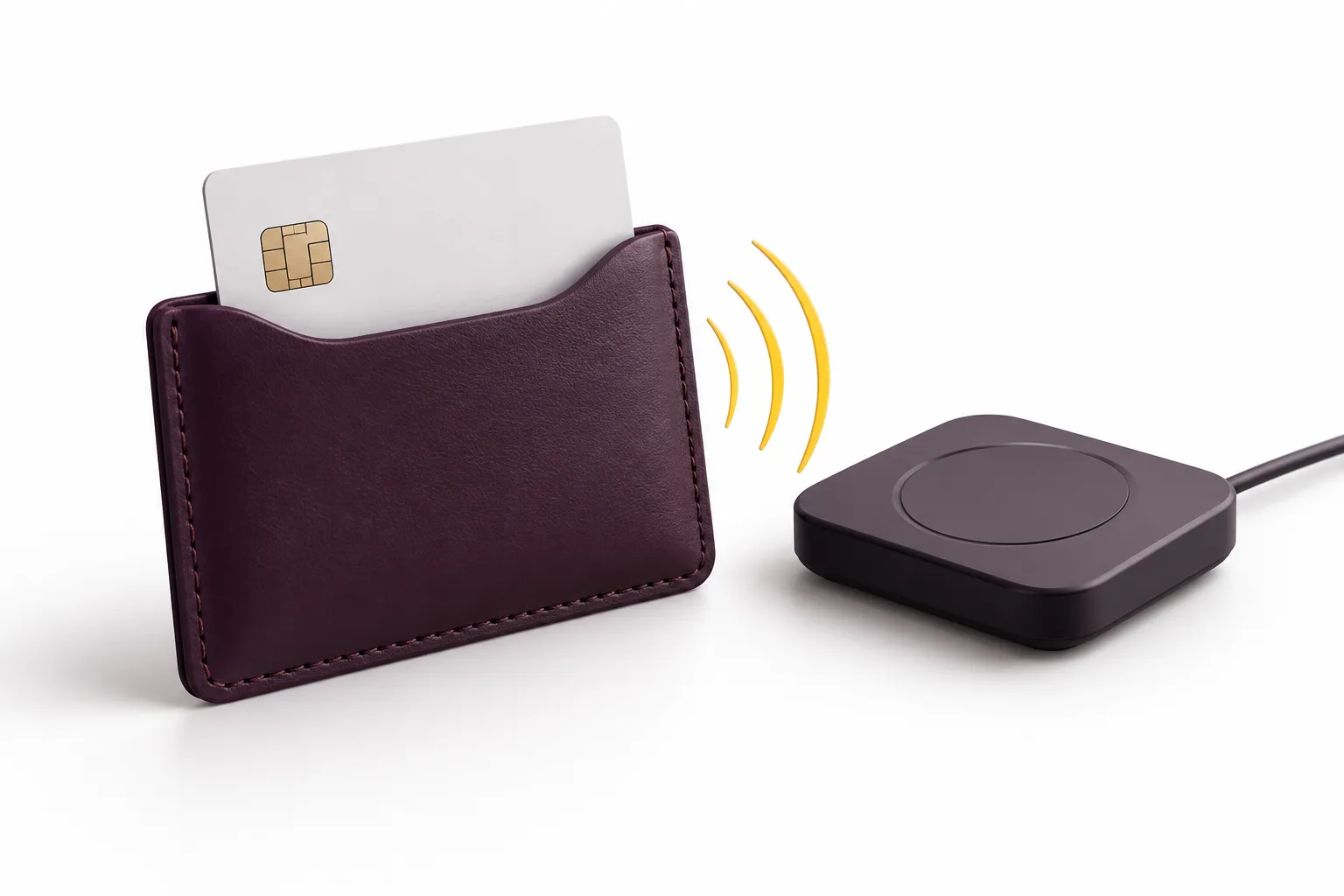
What does an RFID-blocking card holder do?
RFID means radio-frequency identification. In a contactless interaction, a reader and a compatible card communicate without a physical electrical connection. A blocking holder aims to interfere with that interaction while the card is inside its intended protective area. The result must be established for the holder’s actual construction; a fabric ingredient alone is not a test report.
Think of the feature as a boundary around one part of your routine. You remove a card when you want to use it and return it to the designated pocket afterwards. A card in an unprotected exterior slot, or partly protruding from the intended compartment, should not be assumed to have the same protection as the tested arrangement.
This guide explains how to assess a claim. It does not estimate the likelihood of contactless fraud, recommend changing your bank’s settings or describe every form of radio-frequency attack. For a specific payment-card concern, use the issuer’s published support and security guidance.
Check the frequency and the card’s technology.
“RFID” covers more than one technology. NFC, used in contactless applications, operates at 13.56 MHz according to the NFC Forum [1]. A statement about that frequency should not be extended to every access badge, travel credential or identification card. Ask the card issuer or system provider what your particular card uses.
Frequency is one part of compatibility; the communication protocol and test equipment also matter. Two objects described as contactless do not automatically behave identically with a given reader. A holder’s product page should therefore identify the tested scope rather than suggesting that the letters RFID are a universal specification.
| Question | Why it matters | Useful answer |
|---|---|---|
| Which technology? | Contactless payment, access and identification systems can differ. | The card type or protocol covered by the test. |
| Which frequency? | A result for one band is not proof for another. | A stated tested frequency, not only “RFID protected”. |
| Which placement? | Protection may depend on pocket, closure and orientation. | A diagram or instructions showing the tested arrangement. |
EMVCo explains that EMV contactless payments generate a one-time security code for each transaction [2]. Payment security therefore includes mechanisms beyond whether a radio interaction occurs. It would be misleading to imply that a blocking wallet is the only thing between a contactless card and fraudulent use.
What an RFID holder does not protect against.
A holder cannot stop someone persuading you to reveal a password or a one-time code. It cannot secure an online account, prevent a physical wallet from being stolen or hide card details once you take the card out. Those situations sit outside a feature intended to affect contactless communication.
Online payment authentication is a different area. EMVCo’s 3-D Secure framework concerns card-not-present transactions [3]; a fabric layer around a physical card is not a substitute for account authentication or the issuer’s procedures. Keep that distinction in mind when you see broad language such as “fraud-proof”.
Nor is a card holder automatically a shield for a phone, car key or passport. Those products can use different technologies and physical arrangements. Do not extrapolate from a successful card demonstration to another object. Ask for evidence covering the intended use, or treat that use as unverified.
Read the test behind the product claim.
| Claim or detail | Evidence to request | Remaining limit |
|---|---|---|
| Blocking material included | Material specification and location in the product. | An ingredient does not establish finished-holder performance. |
| Card could not be read | Card type, reader, control result, orientation and closure. | One combination does not establish universal compatibility. |
| Independently tested | Named laboratory, report date, model identifier and method. | Check whether the retail design matches the tested sample. |
| All pockets protected | Results covering every claimed pocket and intended loading. | Overfilling or using other positions may fall outside the report. |
A useful report identifies its sample and records what happened. Look for the exact model or construction version, the card and reader setup, the number of positions checked and any exclusions. A supplier’s logo or an unexplained photograph of a meter does not answer these questions.
If the seller cannot provide this information, record the feature as unverified. You can still assess the holder’s dimensions, access and organization, but keep those practical attributes separate from a security-performance promise. A clear admission that testing is pending is more useful than an unsupported percentage.
A practical check needs a working control.
A simple functional check can reveal a mismatch, but it cannot certify a holder. Use only a card and reader you own or are authorized to test, and avoid making purchases or recording sensitive card data for a demonstration. A non-payment test card with a compatible reader is a clearer setup when available.
- Establish a baseline. Confirm that the reader detects the card without the holder. Record the card type and the equipment; if the baseline fails, the holder test says nothing.
- Use the intended pocket. Insert the card fully and close the holder as instructed. Repeat the same approach with the same equipment.
- Check relevant positions. Note front, back and edge orientations, the pocket used and whether the holder is normally loaded. Do not claim a position was tested unless it was.
- Record the narrow result. Write “not detected with this setup” rather than “blocks everything”. If results are inconsistent, ask the manufacturer for its documented method.
A phone that fails to read a card is not enough on its own: the phone or application might not support that card in the first place. That is why the control is essential. Even a repeatable result remains evidence for that setup, not a laboratory certification or a prediction about every possible reader.
Choose a holder that suits your daily routine.
Make a short inventory before choosing: payment cards, access cards, transit cards, folded cash and anything you need to reach quickly. Decide which items belong in a protected pocket and which you intend to remove for use. Trying to tap a card through a pocket designed to block it defeats the intended interaction.
As an example, someone carrying two payment cards, an office access card and a transit card needs four usable positions, but not necessarily four identical access routines. This is a planning example, not a tested ARATE capacity. Check whether the holder remains properly closed when filled with your own combination.
Inspect the physical fit as carefully as the technical claim. Cards should be accessible without being forced, and closure instructions should remain usable at your normal load. Follow the care guidance for the outer finish; a leather appearance does not identify the internal blocking construction or its tested condition after wear.
ARATE’s current evidence status.
The ARATE Card Organizer preview lists a nickel-copper RFID fabric layer in its catalogue description. That is a stated construction feature. ARATE has not yet published a finished-product report confirming tested frequencies, compatible card types, protected pockets or performance after use.
We therefore do not claim that this preview has demonstrated universal blocking or fraud prevention. Ask for final specifications, testing status and launch availability through ARATE’s contact page. The collection remains pre-launch; the website does not currently accept orders.
For a work bag with a dedicated card pocket, make the same distinction between a listed feature and verified performance. Our work-bag materials checklist explains how to request evidence for the whole product rather than relying on one component name.
Sources and scope.
Primary technology sources checked 28 September 2026. These sources explain contactless technology and payment security; they do not certify or endorse ARATE products.
A FEW MORE ANSWERS
Frequently asked questions
Does an RFID card holder stop all card fraud?
No. A feature intended to affect contactless reading does not prevent phishing, account compromise or theft of the physical holder. Follow your card issuer’s security guidance.
Will a 13.56 MHz blocking claim cover every access card?
Do not assume so. Check your card’s technology and the holder’s tested frequency, protocol and placement. Evidence for one setup does not establish every RFID use.
Can I prove blocking with my phone?
Only a supported card and a working control can make a phone check informative. A failure to read the card is not proof if the phone cannot read it outside the holder. A successful check still is not certification.
Has ARATE verified its RFID Card Organizer performance?
ARATE’s catalogue lists a nickel-copper RFID fabric layer. A finished-product report documenting frequencies, compatible cards and protected pockets has not yet been published.